
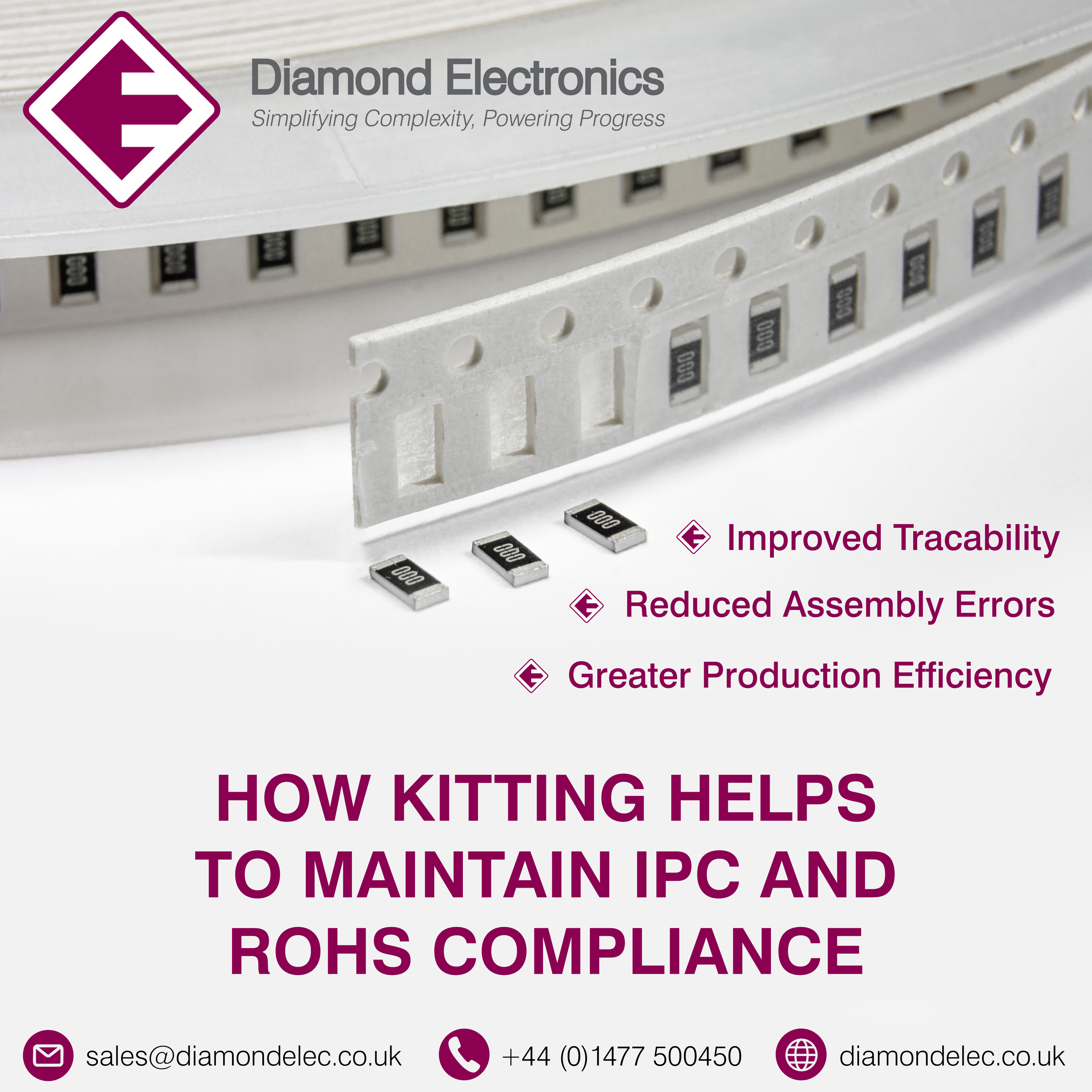
Electronic component kitting plays important role in maintaining both IPC and RoHS compliance, as it creates a controlled, traceable process for managing components before they reach production. This aids your business in their quality and business improvement as component kitting from Diamond creates:
- 100% component traceability
- Reduced risk of RoHS violations
- Improved audit readiness
- Lowe assembly defect rates
- Reduced rework and scrap
- Faster containment of quality issues
- Better supplier accountability
We explore how kitting has benefits across the compliance landscape in this article.
Supporting RoHS compliance
RoHS (Restriction of Hazardous Substances) requires manufacturers to ensure that restricted substances such as lead, mercury, cadmium, hexavalent chromium, PBBs, and PBDEs remain below permitted levels in products. With kitting the process of ensuring this is sped up and standardised by:
1. Preventing component mix ups
Kitting ensures that only RoHS-compliant parts are used for production. By separating procurement and production processes, the correct components can be used, ensuring that compliant versions of components are purchased and verified, instead of non-compliant versions.
2. Maintaining material traceability
With kitting comes the ability to link components to greater traceability standards, with each component lot being able to be linked to:
- Supplier information
- Batch/Lot numbers
- Certificate of Conformity
- RoHS declarations
This traceability is key to not just RoHS compliance but is critical to evidence compliance and ensure standardising within reporting. With kitting the process for traceability is standardised and localised, enabling production to focus on production, instead of documentation.
3. Supporting audits and investigations
If a supplier identifies an issue with RoHS compliance, kitting records allows a manufacturer to identify:
- Which product used the components
- When they were built
- Which customers received them
This helps to reduce the scope and cost of corrective actions, while minimising the administrative workload and time taken to resolve issues.
Supporting IPC compliance
Kitting does not just support environmental compliance. Kitting also helps to support the IPC standards which cover workmanship, assembly quality, handling methods, traceability, and process control.
1. Improved component control
With many IPC standards emphasising the importance of process discipline and traceability. By verifying part numbers, board revisions, and quantities before production starts, kitting reduces the risk of assembly errors which could lead to IPC workmanship failures.
2. Enhanced traceability
IPC standards and associated supply chain declaration standards support having consistent and auditable records. With kitting the traceability is enhanced. At Diamond traceability can include:
- Part numbers
- Supplier
- Date supplied
- Order numbers
- Lot codes
- Date code
- Picking information
This helps to demonstrate compliance and ensure that customers have parts with the correct fit and functionality.
3. Reduction of counterfeit or unapproved parts
The Diamond kitting process ensures that all parts are from Diamond verified suppliers along with a thorough multi point inspection, with X-ray quantity verification. This reduces the likelihood of counterfeit, obsolete, or damaged components reaching your production. This aligns with IPC focus on product reliability and quality management.
4. Better stock rotation and shelf life management
Many electronic components have specific storage requirements to ensure quality within soldering processes. By using a kitting service through Diamond, parts remain within their storage conditions until they make it to the line, with full MSL handling without the need for investment in dry cabinets or MSL sealing systems.
Conclusion
Electronic component kitting is much more than a material staging activity. It acts as a key control point that ensures only approved, traceable, and compliant components reach your production. By maintaining accurate records of part identity, supplier declarations, lot numbers, and usage history, kitting helps manufacturers demonstrate RoHS compliance, satisfy IPC traceability and process control requirements, and reduce the risk of non-conforming products reaching customers.
Follow our linkedin page for further updates: https://www.linkedin.com/company/diamond-electronics-ltd/